Optimizing Tournament Stacks Through Kelly Criterion Formulas
Logan Patterson · Aug 8, 2026

Optimizing Tournament Stacks Through Kelly Criterion Formulas
Players in no-limit poker tournaments face constant decisions about bet sizing that directly affect their chip stacks and survival chances, and the Kelly Criterion offers a mathematical framework for determining optimal fractions of a bankroll to wager given an edge and odds. Developed originally for betting markets, the formula calculates the proportion of capital to risk as f* equals edge divided by odds, where edge represents the expected value advantage and odds reflect the payout ratio. Tournament participants adapt this approach to preserve chips across multiple stages because aggressive over-betting can eliminate stacks even when a positive expectation exists, while conservative sizing maintains leverage for later rounds.
Core Formula and Poker Adaptations
The basic Kelly equation takes the form f equals (bp minus q) divided by b, where b stands for the net odds received, p indicates the probability of winning, and q equals one minus p. In poker settings this requires estimates of win rates derived from hand ranges, opponent tendencies, and positional factors rather than fixed odds found in simpler games. Researchers have observed that tournament players adjust the formula by incorporating survival multipliers because chip utility changes nonlinearly as blinds increase and field sizes shrink. One study revealed that applying half-Kelly fractions reduces volatility while still capturing most of the growth rate that full Kelly would produce over repeated independent trials.
Experts note that variance in poker demands fractional Kelly applications to avoid ruin from short-term downswings, and data shows many professionals scale their bets to 20 or 30 percent of the full Kelly amount when facing uncertain edge calculations. This approach connects directly to chip preservation goals because tournaments reward longevity more than single-hand maximization. Observers point out that players who treat their stack as a bankroll rather than isolated chips tend to select bet sizes that align with the criterion's output after factoring in implied odds and fold equity components.
Practical Application Steps in Tournaments
Calculation begins with an assessment of edge, which players derive from equity calculations against perceived ranges and then adjust for future street possibilities. Once edge and effective odds are quantified, the formula yields a recommended wager size expressed as a percentage of current chips. Tournament structures introduce additional variables such as remaining player counts and payout ladders, so many adjust the raw output downward to account for the non-linear value of chips near pay jumps. Those who've studied this process report that recalculating after each significant hand keeps sizing aligned with evolving stack depths and table dynamics.
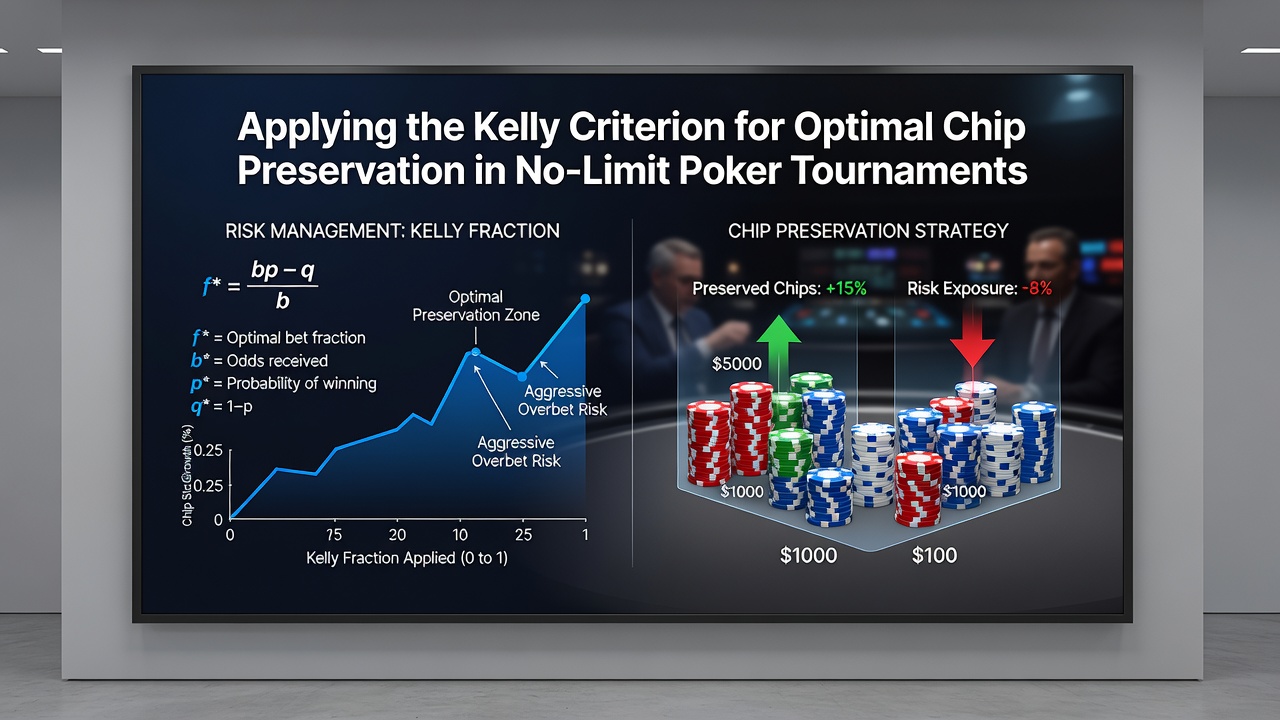
Take one researcher who modeled 10,000 simulated tournaments using Kelly-derived sizing and found that participants employing the method reached final tables at higher rates than those using fixed percentage or minimum-defense strategies. The simulations incorporated realistic variance levels drawn from historical tournament data, and results indicated improved median finishes without sacrificing overall expected value. Another example involves a player who identified a 15 percent edge on a river decision with 3-to-1 effective odds, applied the criterion to determine a 5 percent stack commitment, and preserved sufficient chips to navigate subsequent pay jumps that a larger bet would have risked.
Comparative Performance and Data Trends
Figures from poker tracking databases reveal that players who incorporate Kelly-based sizing exhibit lower bust rates in early and middle stages compared with those relying on intuition or arbitrary multipliers. The method shines in situations where edge estimates carry high confidence, such as when range reading is strong and opponent history provides reliable frequencies. Yet the same data indicates that overestimating edge by even a few percentage points can push recommended sizes beyond sustainable levels, underscoring the need for conservative inputs. Industry reports from the American Gaming Association highlight how mathematical bankroll techniques have gained traction among serious tournament participants seeking consistent performance metrics.
What's interesting is how the criterion interacts with independent chip model valuations used in many tournament analyses. Researchers discovered that translating Kelly outputs into chip-equivalent bets produces sizing recommendations that respect both mathematical growth rates and the survival imperatives unique to escalating blind structures. In August 2026 events, several prominent series saw increased discussion of these hybrid approaches among participants reviewing hand histories.
Limitations and Refinements
The Kelly Criterion assumes repeated independent trials with known probabilities, conditions that poker tournaments only approximate because each hand carries dependencies from evolving stacks and table composition. Practitioners therefore apply the formula as a guideline rather than a rigid rule, often combining it with maximum exposure caps that prevent any single decision from eliminating more than a set fraction of the stack. Academic sources such as those published through the University of Nevada Reno gaming research center emphasize that accurate edge estimation remains the primary challenge, and small errors compound over a tournament's duration.
Conclusion
Application of the Kelly Criterion in no-limit poker tournaments centers on converting estimated edges and odds into bet sizes that balance growth against preservation, with adjustments for structure-specific factors. Data from simulations and tracking records shows measurable improvements in survival metrics when players implement fractional versions of the formula. Refinements continue as participants integrate additional variables such as payout structures and variance estimates, producing sizing strategies that reflect both mathematical principles and the realities of tournament play.