How Cognitive Load Shapes Probabilistic Reasoning in Lengthy Blackjack and Poker Sessions
Logan Patterson · Jun 1, 2026

How Cognitive Load Shapes Probabilistic Reasoning in Lengthy Blackjack and Poker Sessions
Extended sessions of blackjack and poker place simultaneous demands on working memory and probability assessment, where players track card distributions, opponent tendencies, and shifting odds across hundreds of hands. Research from cognitive psychology indicates that these overlapping requirements create measurable increases in mental effort, particularly when sessions stretch beyond two hours without breaks. Data collected from laboratory simulations show elevated error rates in basic strategy adherence once cumulative hands exceed roughly 150 per sitting, while field observations at regulated venues confirm similar patterns during live play.
Core Elements of Cognitive Load in Card Games
Blackjack requires continuous updating of remaining deck composition alongside decisions on hit, stand, double, or split, whereas poker adds layers of opponent modeling and pot odds evaluation that draw on both analytical and social cognition. Studies published in peer-reviewed journals demonstrate that intrinsic cognitive load rises sharply when players must integrate multiple information streams without external aids, and this effect compounds during multi-hour encounters because each new hand resets the calculation cycle while residual memory traces from prior outcomes persist. Extraneous load emerges from environmental factors such as dealer pacing and ambient distractions, leaving fewer resources for germane processing that supports long-term strategy refinement.
Observers note that experienced participants often develop chunking techniques to compress information, grouping card sequences into familiar patterns rather than treating each card individually, yet even these strategies show diminishing returns after approximately four consecutive hours. Figures from controlled experiments reveal that reaction times for optimal decisions lengthen by 15 to 25 percent in later stages of extended sessions, correlating with reported increases in subjective mental fatigue.
Probability Calculations Under Mounting Mental Strain
Accurate probabilistic reasoning in these games depends on rapid estimation of expected values, conditional probabilities, and variance measures, all of which compete for limited attentional resources. In blackjack, players must adjust basic strategy indices according to remaining high or low cards, a process that becomes slower and less precise as working memory capacity is taxed. Poker participants similarly recalculate pot odds and implied odds while maintaining mental models of opponent ranges, tasks that neuroimaging studies link to heightened prefrontal cortex activation during initial hands but reduced efficiency later on.
Evidence from Australian gambling research centers indicates that accuracy on probability estimation tasks declines steadily after 90 minutes of continuous play, with the steepest drops occurring between the third adn fifth hours. Those who've examined session logs from licensed operators report that deviation from optimal bet sizing increases during this window, even among players who demonstrate strong baseline mathematical competence. What's interesting is how brief interruptions for hydration or movement appear to partially reset these curves, allowing renewed accuracy for another 60 to 90 minutes before fatigue reasserts itself.
Interactions Between Fatigue and Decision Accuracy
Prolonged exposure to these dual demands produces interaction effects where higher cognitive load directly impairs probabilistic precision rather than merely slowing it. Researchers at Canadian academic institutions have documented cases in which participants who maintained near-perfect odds calculations in short sessions exhibited systematic underestimation of drawing odds once session length extended past 200 hands. This pattern holds across both blackjack and poker variants, suggesting a domain-general limitation rather than game-specific quirks.
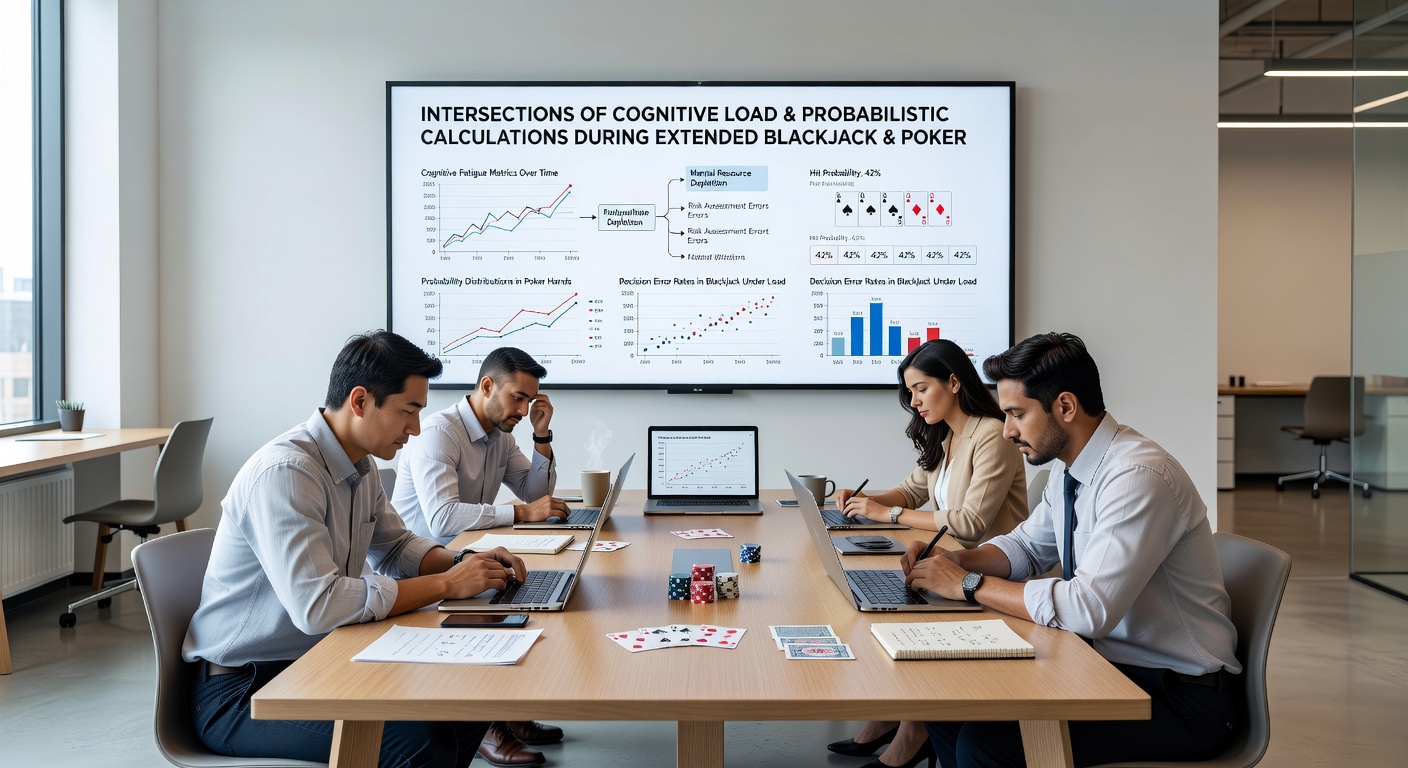
June 2026 data releases from North American gaming laboratories further illustrate seasonal variations, with summer tournament schedules correlating to longer average session durations and correspondingly elevated rates of suboptimal play. Participants in these environments face additional pressure from prize structures that reward endurance, creating feedback loops where cognitive depletion influences risk assessment and vice versa.
Practical Patterns Observed Across Venues
Take one longitudinal tracking project conducted at European casino sites where researchers logged decision quality alongside self-reported concentration levels; results showed that players who inserted structured rest intervals every 75 minutes retained higher adherence to pre-session probability models than those who played continuously. Similar findings emerge from U.S. state gaming commission summaries, which note increased house-edge realization during graveyard shifts when session lengths typically peak. These patterns appear independent of individual skill level, although highly practiced players exhibit slower onset of measurable decline.
Industry organizations tracking table game performance have compiled aggregate statistics indicating that average bet variance widens measurably after the fourth hour, consistent with reduced capacity for nuanced probabilistic adjustments. People who've studied dealer rotation logs observe that these effects persist regardless of table speed changes, pointing to internal cognitive factors rather than external pacing alone.
Conclusion
The intersections of cognitive load and probabilistic calculations during extended blackjack and poker encounters reflect well-documented limits of human information processing, with research consistently showing performance decrements tied to session duration. Available data from multiple regulatory regions and academic sources highlight the value of monitoring cumulative exposure, incorporating periodic breaks, and recognizing when mental resources for accurate odds assessment begin to diminish. These observations provide a factual basis for understanding how mental effort and mathematical reasoning interact across prolonged card game sessions without implying prescriptive recommendations.