Game Theory Models Shaping Bluff Decisions in Tournament Poker
Dana Flores · Aug 10, 2026

Game Theory Models Shaping Bluff Decisions in Tournament Poker
Mathematical models based on game theory now guide bluff frequency calculations for players in tournament settings, where stack sizes, payout structures, and opponent tendencies create dynamic decision environments. Researchers developed these frameworks over decades, drawing from equilibrium concepts that balance risk and reward across multiple hands. Data from major events shows players who apply such models adjust their bluff rates according to specific variables rather than fixed percentages.
Core Equilibrium Concepts in Bluff Calculations
Game theorists established Nash equilibrium as a foundation for optimal bluffing, where no player gains an advantage by deviating from a mixed strategy that includes both value bets and bluffs at precise ratios. In tournament play, this translates to solvers calculating frequencies based on pot odds and fold equity, since the Independent Chip Model assigns different values to chips depending on remaining stack depths and payout ladders. Observers note that solvers output ranges where bluff frequency often falls between 25 and 40 percent in certain river spots, though these numbers shift when ICM pressure increases near pay jumps.
Studies from academic institutions confirm that equilibrium strategies require randomization to prevent exploitation, which means players must bluff at rates that make opponents indifferent between calling and folding. One analysis released in August 2026 examined final table data from several international circuits and found that participants who deviated more than 8 percent from solver-recommended frequencies experienced measurable declines in expected value over large sample sizes.
Adjustments for Stack Depth and Payout Pressure
Tournament formats introduce variables absent from cash games, so models incorporate stack-to-pot ratios alongside ICM multipliers that reduce the value of chips as fields narrow. When stacks drop below 20 big blinds, solvers recommend tighter bluff frequencies because the risk of busting outweighs potential gains from successful folds. Researchers at institutions focused on combinatorial game theory demonstrated that deeper stacks allow wider bluff ranges since implied odds and future betting rounds provide additional leverage.
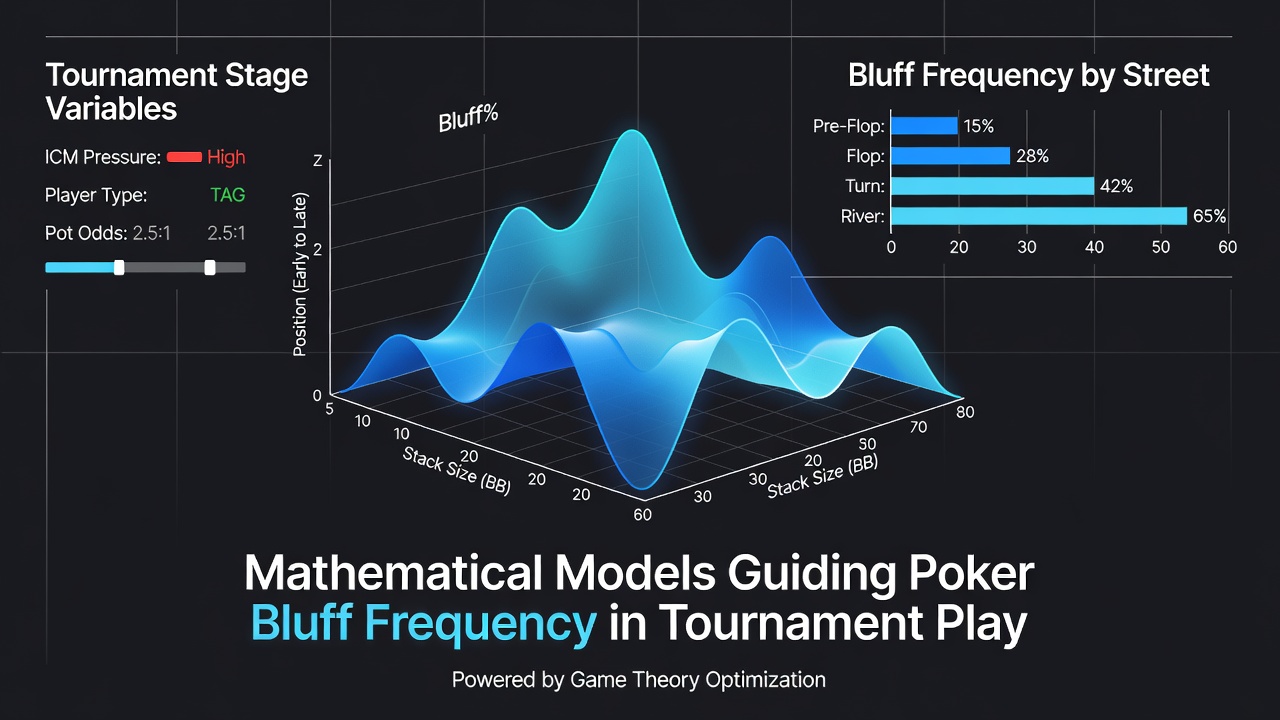
Evidence from tracking software used in live and online tournaments reveals that players near the money bubble reduce bluff attempts by an average of 15 percent compared to early stages, a pattern consistent with ICM-aware calculations. Those who studied these adjustments across multiple series observed that the shift occurs gradually rather than at a single threshold, allowing models to predict optimal timing for frequency changes.
Opponent Modeling and Range Construction
Advanced frameworks integrate opponent-specific data into base equilibrium strategies, since real-world opponents rarely play perfect ranges. Bayesian updating techniques allow models to refine bluff frequencies when historical tendencies show higher fold rates to certain bet sizes. Industry reports from organizations tracking professional play indicate that incorporating such adjustments improves overall performance metrics when sample sizes exceed several thousand hands.
Range construction remains central because solvers generate mixed strategies only after defining the full distribution of possible holdings. Players apply these outputs by selecting bluff combinations that block key value hands or complete unlikely draws, maintaining balance across the decision tree. Data indicates that maintaining this balance requires tracking multiple variables simultaneously, including board texture and prior action sequences.
Practical Implementation in Live Settings
Software tools now deliver real-time solver outputs during breaks or through precomputed charts tailored to common tournament structures. Participants who integrate these tools report more consistent application of calculated frequencies, though live read-based deviations still occur when physical tells or timing patterns contradict model recommendations. Academic papers on decision science note that successful integration depends on understanding when to override algorithmic suggestions based on new information.
Training regimens at poker academies emphasize repeated exposure to solver scenarios to internalize frequency adjustments rather than memorizing specific numbers. This approach builds intuitive calibration that aligns closer to equilibrium play across varied stack depths and table dynamics.
Conclusion
Mathematical models continue to evolve as computing power and data collection improve, providing increasingly precise guidance on bluff frequencies in tournament environments. Players who reference these frameworks adjust their strategies according to measurable variables while recognizing that opponent adaptation remains an ongoing factor. Continued research from multiple regions supports the ongoing refinement of these tools for competitive play.